


TECHNICAL GUIDE · CUTTING LENGTH
Measure the cut Choose the cutter
The 60×120 cm label describes a format. It does not tell you whether the planned line runs parallel to the shorter edge, runs along the long side or joins one corner to the opposite corner.
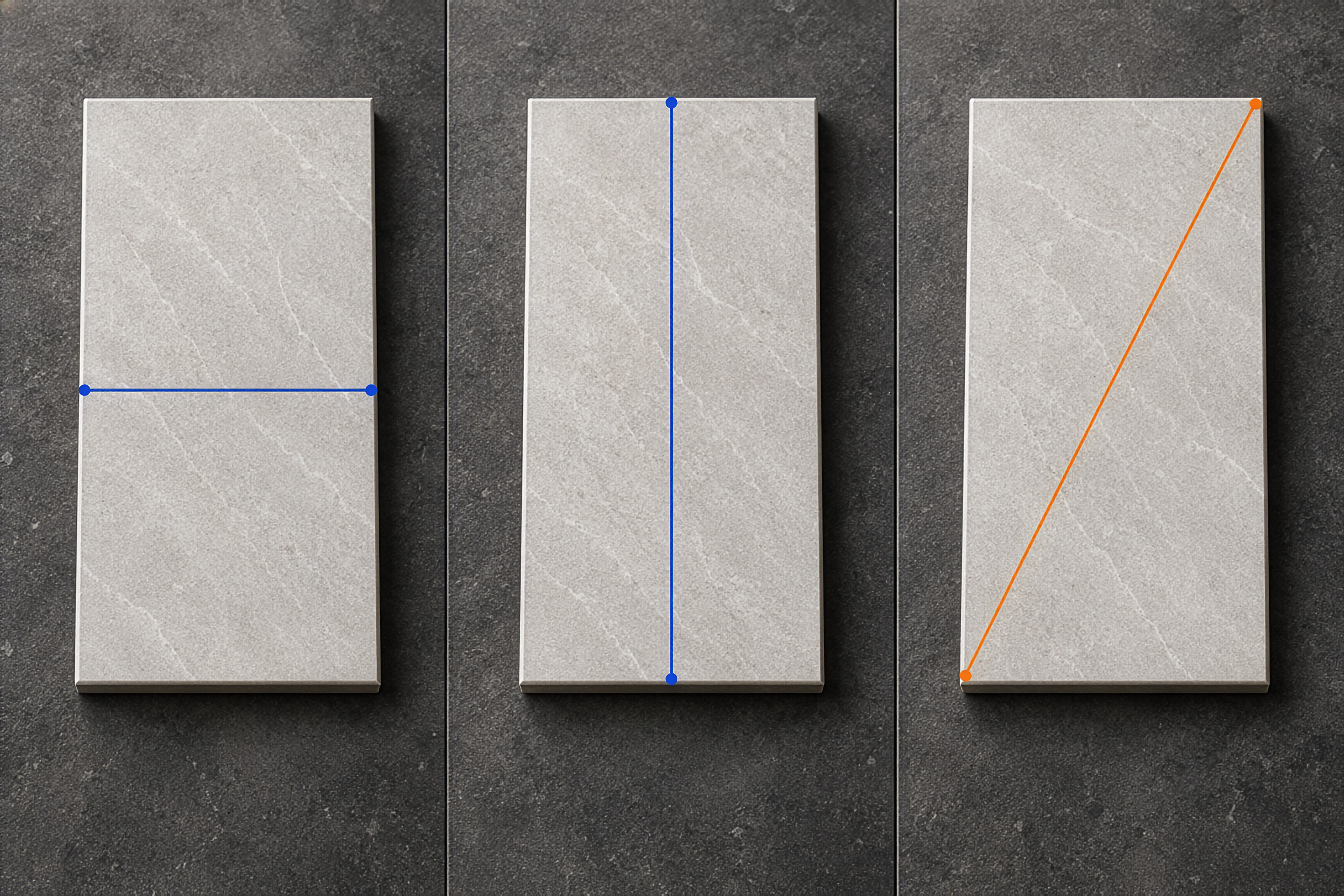
598 × 1198 mm is a hypothetical measured example used for the calculation, not a product measurement or a tolerance attributed to any brand. The figure shows the length of a line on the material; it says nothing about working reach or the choice of method.
Jump to topic
Before comparing cutters, draw the actual line and calculate its length on the real piece.
01 Three lines on the same tile
On a portrait rectangle, with the short side horizontal and the long side vertical, the directions can be stated without rotating the tile:
- A — cross-cut: a line from the left edge to the right edge, parallel to the shorter edge;
- B — lengthwise: a line from the top edge to the bottom edge, along the long side;
- C — full diagonal: a line from one corner to the opposite corner.
These define direction, not how to operate a tool. On a nominal 600 × 1200 mm format, the three lines are not equal. Use the measured size and the actual endpoints from the job when selecting a tool.
02 Worked example with measured-size inputs
Suppose the tile labelled 60×120 measures 598 × 1198 mm in this example. These are hypothetical inputs for the calculation, not a product tolerance or a measurement attributed to any brand.
| Planned line | Calculation | Example length |
|---|---|---|
| A. Cross-cut, parallel to the short edge | short side | 598 mm |
| B. Lengthwise, parallel to the long edge | long side | 1198 mm |
| C. Full corner-to-corner diagonal | √(598² + 1198²) | about 1339 mm |
The full diagonal is:
√(598² + 1198²) = √1,792,808 ≈ 1,338.96 mm, or approximately 1,339 mm.
Do not round that number down when comparing working reach. Do not assume every angled line is a full diagonal either: if it begins or ends away from a corner, calculate the distance between its real endpoints.
03 Nominal format is not the job measurement
Actual tile dimensions can differ from the nominal format name, and a project may use a particular calibre. Measure the piece intended for the job and record:
- actual width and length;
- both endpoints of the planned line;
- tile orientation;
- retained side;
- material and thickness;
- applicable support and method from the relevant instructions.
The joint and installed dimensions belong to the project. Tool working length concerns the line made on the material. Do not combine those values in one field.
04 Line length does not choose the method
A line of 598, 1198 or 1339 mm tells you the span that must be accommodated. It does not yet tell you:
- whether the material suits scoring and breaking;
- whether the job requires wet cutting;
- whether a rail system is applicable;
- what the finished edge must look like;
- which support the material and tool manufacturers require.
Do not choose a model because a number in its name is larger than the result. Check the definition of working length, configuration, instructions and actual tile position.
05 Cutting-length card
| Field | Record |
|---|---|
| Tile | nominal format / actual width / actual length |
| Line | start point / endpoint / direction |
| Result | calculated complete line length |
| Material | type / product / thickness |
| Method | confirm through the applicable guide and instructions |
| Support | material and tool requirements |
| Edge | concealed / processed further / exposed |
Take this card to our guide to choosing a tile cutter. The guide then routes the job to the relevant product family. If the line or material is unclear, send RAIZI a drawing with both endpoints.